Showing posts with label hohner accordion. Show all posts

Tuesday, January 17, 2012

Hohner Concertinas

Having A Great Experience With Hohner Concertinas

Hohner concertinas. The word concertina refers to a family of hand-held bellows-driven free reed instruments constructed according to various systems. A concertina is a free-reed musical instrument, like the various accordions  and the harmonica. It has a bellows and buttons typically on both ends of it. When pressed, the buttons travel in the same direction as the bellows, unlike accordion buttons which travel perpendicularly to it. Also, each button produces one note, while accordions typically can produce chords with a single button.

Hohner Concertinas
Hohner concertina was developed in England and Germany, most likely independently. The English version was invented in 1829 by Sir Charles Wheatstone and a patent for an improved version was filed by him in 1844. The German version was announced in 1834 by Carl Friedrich Uhlig. Because the hohner concertina was developed nearly contemporaneously in England and Germany, systems can be broadly divided into English, German, and Anglo-German types. To a player proficient in one of these systems, hohner concertinas constructed according to a different system may be quite unfamiliar.

English Type

English style hohner concertinas traditionally share several features:
    * Unisonoric (push and draw on each button yield the same note);
    * Fully chromatic;
    * Reeds individually mounted on a frame, laid flat on a chambered reedpan with a pair of reeds in each chamber;
    * Each button has a pivot;
    * Hexagon shaped ends (though octagons and other shapes were produced as well, see above)).

German Type

German style hohner concertinas traditionally share several features:
    * Bisonoric (each button produces a different note on the push and the draw of the bellows);
    * Diatonic or semi-chromatic;
    * Reeds are mounted on a long plate, with separate chambers for each set of reeds;
    * The buttons in each row pivot on a shared pivot arm;
    * Square shaped ends.

Frequently, German hohner concertinas also use more than one reed for each note to produce a fuller sound. Depending on the manufacturer, each note may have up to five reeds spread across three octaves. Sometimes these reeds may be slightly out of tune with each other in order to produce a vibrato effect; this is called wet, musette, or Chicago tuning. With dry or Minnesota tuning the reeds are in tune with each other and do not produce this effect. There is also the traditional tuning of an octave spread as establish by Herr Lange in the nineteenth century.

One of  types of Hohner concertinas is Chemnitzer concertina. A Hohner Chemnitzer concertina is a musical instrument of the hand-held bellows-driven free-reed category, sometimes called squeezeboxes. Hohner Chemnitzer concertina is most closely related to the Bandoneón  (German spelling: Bandonion), more distantly to the other concertinas, and accordions. There are various German hohner concertina systems which share common construction features and core button layout. In the United States, particularly in the Midwest, the term "concertina" often refers to the Chemnitzer concertina. Chemnitzer Concertinas are bisonoric (see above) and are closely related to the bandoneón, but with a somewhat different keyboard layout and decorative style, with some mechanical innovations pioneered by German-American instrument builder and inventor Otto Schlicht.

Hohner Chemnitzer concertina has been predominantly used in folk music, especially Polka  music played in Central and Eastern Europeans and by nineteen- and twentieth century immigrants to the United States from those regions. However hohner concertinas with Chemnitzer, especially in its 52-button and larger versions, is capable of performing in other musical contexts.


Article You May Be Interested In :  Hohner Panther

Wednesday, July 27, 2011

Hohner Panther

Hohner Panther Beginner Diatonic Accordion

Hohner Panther. Hohner Panther Accordion features 31 treble keys, 12 bass/chord buttons, 2 sets of treble reeds, and new double-strap brackets.

Hohner Panther
The Hohner Panther Accordion is 12 inches high x 7-1/2 in. deep and weighs 9 lbs. Plays in G, C, and F.

Almost all music genre is simply perfect be played with this instrument and the perfect beginner diatonic accordion. Hohner Panther  has a timeless quality with its unforgettable sound. Hohner Panther offers and develop your own personal style, let’s get the great feeling and enjoyment with this awesome instrument.


 Article You May Be Interested In : Hohner 270

Tuesday, July 12, 2011

Hohner Blues Harmonica

Hohner Blues Harmonica

Hohner Blues Harmonica. Hohner Blues Harmonica is part of Hohner's new Modular System. The wood resists swelling, and replacement reed plates are available for it.

Hohner Blues Harmonica
Hohner Blues Harmonica is about as cheap as you'd want to go. It's less than $7. You'll probably want something better fairly soon though and at that point you'd have a better idea of which direction you'd like to go.

If you're going to carry it, you will actually be aware of its weight. Compare to other harmonicas,  Hohner Blues Harmonica is lighter, that is why it is easier to blow and make your tune. But don’t even worry of losing it, because Hohner Blues Harmonica comes with a little bag, you can put it there and have it safe.


Article You May Be Interested In : Hohner Melodica

Hohner Guitar

Hohner Guitar

Hohner Guitar. Hohner Guitar is typically strung with nylon strings, plucked with the fingers, played in a seated position and are used to play a diversity of musical styles including classical music. The classical guitar's wide, flat neck allows the musician to play scales, arpeggios, and certain chord forms more easily and with less adjacent string interference than on other styles of hohner guitar. Flamenco guitars are very similar in construction, but are associated with a more percussive tone.

Hohner Guitar
In Mexico, the popular mariachi  band includes a range of guitars, from the tiny requinto  to the guitarrón, a guitar larger than a cello, which is tuned in the bass register. In Colombia, the traditional quartet includes a range of instruments too, from the small bandola (sometimes known as the Deleuze-Guattari, for use when traveling or in confined rooms or spaces), to the slightly larger tiple, to the full sized classical guitar. The requinto also appears in other Latin-American countries as a complementary member of the hohner guitar family, with its smaller size and scale, permitting more projection for the playing of single-lined melodies. Modern dimensions of the classical instrument were established by the Spaniard Antonio de Torres Jurado (1817-1892).


Article You May Be Interested In : Hohner Harmonica

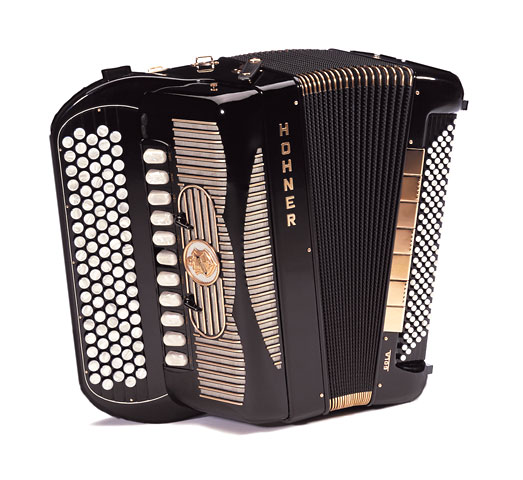
Hohner Accordion

Hohner Accordion Instrument

Hohner Accordion. Hohner Accordion is a box-shaped musical instrument of the bellows-driven free-reed aerophone family, sometimes referred to as a squeezebox. A person who plays the accordion is called an accordionist.

Hohner Accordion
Hohner Accordion is played by compressing or expanding a bellows whilst pressing buttons or keys, causing valves, called pallets, to open, which allow air to flow across strips of brass or steel, called reeds, that vibrate to produce sound inside the body.

The instrument is sometimes considered a one-man-band as it needs no accompanying instrument. The performer normally plays the melody on buttons or keys on the right-hand manual, and the accompaniment, consisting of bass and pre-set chord buttons, on the left-hand manual.

Hohner Accordion is often used in folk music in Europe, North America and South America. It is commonly associated with busking. Some popular music acts also make use of the instrument. Additionally, Hohner Accordion is sometimes used in both solo and orchestra performances of classical music.

The oldest name for this group of instruments is actually harmonika, from the Greek harmonikos, meaning harmonic, musical. Today, native versions of the name hohner accordion are more common. These names are a reference to the type of hohner accordion patented by Cyrill Demian, which concerned "automatically coupled chords on the bass side".


Article You May Be Interested In : Accordion History

Wednesday, June 29, 2011

Accordion History

History of Accordion

The accordion is a free reed instrument and is in the same family as other instruments such as the sheng and khaen. The sheng and khaen are both much older than the accordion and this type of reeds did inspire the kind of free reeds in use in the accordion as we know it today. Look at Free reed aerophone History for more details.
8-key bisonoric diatonic accordion (c. 1830s)

hohner accordion
The accordion's basic form is believed to have been invented in Berlin in 1822 by Christian Friedrich Ludwig Buschmann,[notes 4] although one instrument has been recently discovered that appears to have been built earlier. Engraved Name F. Löhner.

The accordion is one of several European inventions of the early 19th century that used free reeds driven by a bellows. An instrument called accordion was first patented in 1829 by Cyrill Demian, of Armenian descent, in Vienna.

Demian's instrument bore little resemblance to modern instruments. It only had a left hand buttonboard, with the right hand simply operating the bellows. One key feature for which Demian sought the patent was the sounding of an entire chord by depressing one key. His instrument also could sound two different chords with the same key; one for each bellows direction (a bisonoric action).

The piano accordion was played in German speaking regions, then all over Europe. Some early portable Instrument with piano keys had been invented in 1821, but it started to actually be played much later, and built its reputation from there. At that time in Vienna, mouth harmonicas with Kanzellen (chambers) had already been available for many years, along with bigger instruments driven by hand bellows. The diatonic key arrangement was also already in use on mouth-blown instruments. Demian's patent thus covered an accompanying instrument: an accordion played with the left hand, opposite to the way that contemporary chromatic hand harmonicas were played, small and light enough for travelers to take with them and used to accompany singing. The patent also described instruments with both bass and treble sections, although Demian preferred the bass-only instrument owing to its cost and weight advantages.

By 1831 at least the accordion had appeared in Britain. The instrument was noted in The Times of that year as one new to British audiences  nd not favourably reviewed, but nevertheless it soon became popular. It had also become popular with New Yorkers by at least the mid-1840s. The first pages in Adolph Müller's accordion book

The musician Adolph Müller described a great variety of instruments in his 1833 book, Schule für Accordion. At the time, Vienna and London had a close musical relationship, with musicians often performing in both cities in the same year, so it is possible that Wheatstone was aware of this type of instrument and may have used them to put his key-arrangement ideas into practice.

Jeune's flutina resembles Wheatstone's concertina in internal construction and tone color, but it appears to complement Demian's accordion functionally. The flutina is a one-sided bisonoric melody-only instrument whose keys are operated with the right hand while the bellows is operated with the left. When the two instruments are combined, the result is quite similar to diatonic button accordions still manufactured today.

Further innovations followed and continue to the present. Various buttonboard and keyboard systems have been developed, as well as voicings (the combination of multiple tones at different octaves), with mechanisms to switch between different voices during performance, and different methods of internal construction to improve tone, stability and durability.

Source: wikipedia